Bitcoin P2P: Africa's Banking Alternative
While traditional financial institutions globally define banking as a safe haven for capital and a conduit for its movement, this promise remains unfulfilled for a staggering portion of the African population. As of 2024, only 43.9% of adults in Sub-Saharan Africa hold an account at a formal financial institution. This systemic exclusion has paved the way for a quiet revolution: the rise of Peer-to-Peer (P2P) Bitcoin trading. Far from being a mere speculative asset, Bitcoin has emerged as a pragmatic infrastructure for financial inclusion, filling the void left by a legacy banking system that is often too distant, too expensive, or too restrictive for the average citizen.
The Trust and Access Deficit
The "access problem" in Africa is often a matter of structural barriers. For many, the requirements to open a traditional bank account - such as high minimum balances and formal documentation - are insurmountable. This is compounded by a significant gender gap; in 2024, only 52% of women had a financial account compared to 64% of men. P2P trading sidesteps these hurdles by leveraging the continent's high mobile penetration. With 84% of adults in low and middle-income countries owning a mobile phone, the infrastructure for a new financial system is already in every pocket.
Beyond physical access lies the "trust dimension". In regions where bank collapses or sudden currency redesigns are within living memory, institutional trust is a rare commodity. P2P platform like Hodl Hodl do not ask users to trust a distant corporation with their life savings. Instead, they facilitate direct trades between individuals, secured by escrow contracts and reputation systems. This decentralized model shifts the burden of trust from an entire institution to a single, verifiable counterparty for a specific transaction.
Escaping Currency Devaluation
For many African nations, the challenge is not just accessing a bank, but protecting the value of the money held within it. The Nigerian Naira, for instance, plummeted from approximately 460 NGN/USD in early 2023 to nearly 1,500 NGN/USD by early 2025. In such environments, a bank account denominated in local currency is less a tool for savings and more a witness to the erosion of wealth.
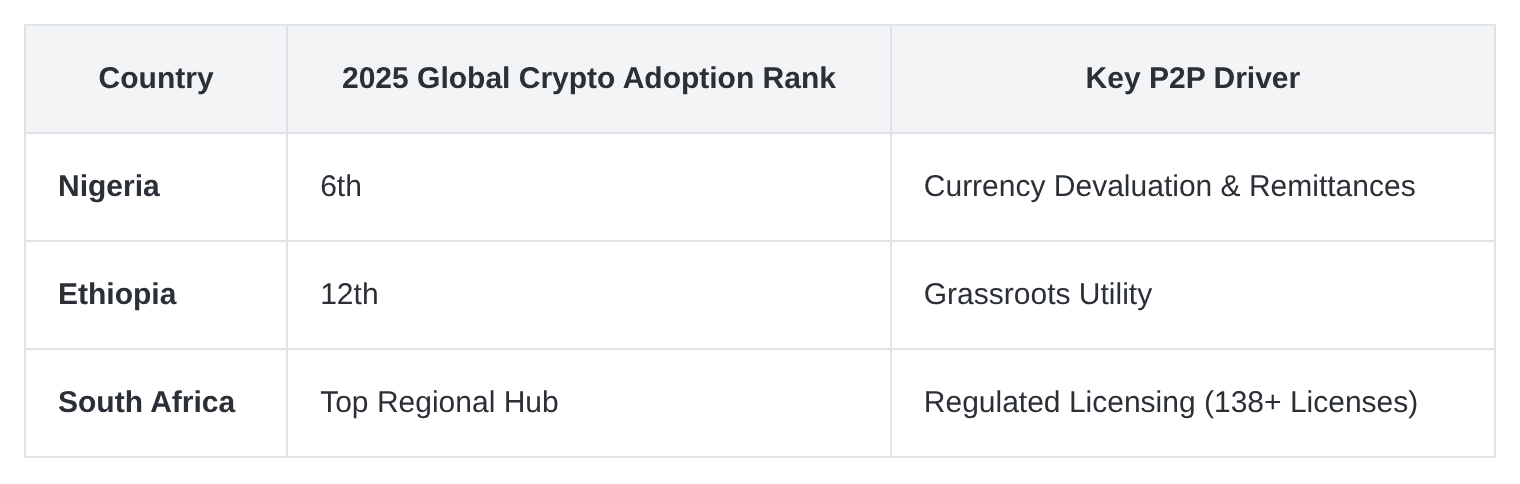
Bitcoin offers an exit ramp from this volatility. By trading local currency for Bitcoin on P2P markets, individuals can hold an asset that exists outside the inflationary pressures of their national economy. This is particularly vital in countries where access to foreign exchange is strictly rationed by the state. Nigeria has subsequently become the world's second-largest Bitcoin P2P market, trailing only the United States, as citizens seek stability through digital assets.
The Power of Payment Flexibility
The genius of P2P Bitcoin trading lies in its adaptability to existing "money rails". Unlike traditional banks, which operate on rigid, siloed systems, P2P buyers and sellers can agree on any payment method. Across Africa, this increasingly means mobile money.
Someone with an M-Pesa account in Kenya, an MTN Mobile Money account in Ghana, or Airtel Money anywhere on the continent can trade Bitcoin using the same tools they use for groceries and utility bills.
This flexibility allows Bitcoin to integrate seamlessly with informal financial traditions. For decades, rotating savings clubs and community lending circles have served the unbanked. P2P trading shares this community-centric DNA, relying on direct relationships rather than a distant head office. It is not a replacement for these social structures but a digital extension of them.
A Pragmatic Financial Tool
It is important to acknowledge that P2P trading is not a perfect substitute for all banking functions. It lacks the deposit insurance and consumer protections of regulated institutions, and Bitcoin’s own price volatility remains a significant risk factor. However, for millions of people, the choice is not between a "perfect" bank and Bitcoin; it is between a currency losing value and a digital alternative that actually works on their own terms.
As regulatory landscapes evolve - with South Africa issuing over 138 licenses to crypto service providers and Nigeria recognizing digital assets as securities under the Investments and Securities Act 2025 - the bridge between traditional finance and P2P markets is strengthening. For the unbanked millions across the continent, P2P Bitcoin trading is more than a trend; it is the first financial tool that has ever truly given them a seat at the table.