The Digital Shilling Revolution: How M-Pesa Paved the Way for Bitcoin in Kenya
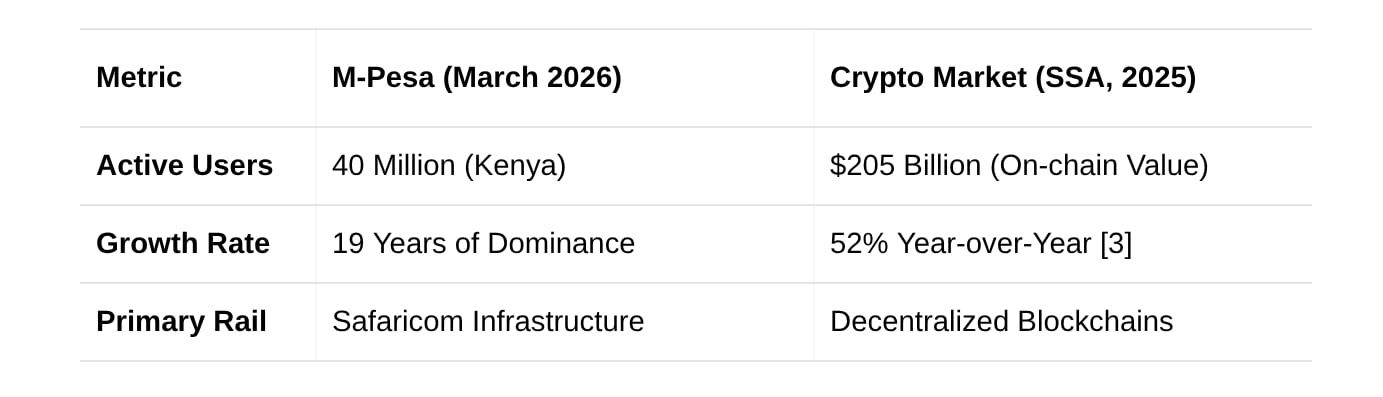
In Kenya, the definition of "money" has long been synonymous with the phone in one's pocket. Since its launch in 2007, M-Pesa has transformed from a simple mobile money service into a national financial rail, boasting over 40 million monthly active customers as of March 2026 [1]. This two-decade legacy of mobile-first finance has done more than just digitize the Kenyan Shilling; it has created a population that is uniquely primed for the adoption of Bitcoin. For many Kenyans, the transition from M-Pesa to a Bitcoin wallet is not a leap into the unknown, but a natural evolution of a digital habit they have practiced for nearly twenty years.
A Shared Digital DNA
The synergy between M-Pesa and Bitcoin is structural. M-Pesa proved that a vast population could manage its financial life without a traditional bank account, building a foundation of trust in phone-based transactions. Today, this trust is the primary engine for Kenya's thriving Peer-to-Peer (P2P) Bitcoin market. On platforms like Binance P2P and Noones, M-Pesa is the dominant payment method. Traders send Shillings directly from their M-Pesa balances to a seller, while the Bitcoin is held in a secure escrow — a process that mirrors the instant settlement and mobile-centric nature of M-Pesa itself.
The Regulatory Turning Point
For years, Kenya’s crypto market operated in a legal gray zone. However, 2025 marked a decisive shift toward formalization. The Virtual Asset Service Providers (VASP) Act 2025, enacted in November, established a comprehensive framework for the industry [2]. Under this new regime, a dual-regulator model has emerged: the Central Bank of Kenya (CBK) oversees payment-related services and stablecoins, while the Capital Markets Authority (CMA) supervises investment platforms and exchanges.
As of early 2026, the National Treasury has unveiled draft VASP Regulations that require all service providers to be registered as Kenyan companies with robust anti-money laundering (AML) protocols [4]. While the licensing process is still in its nascent stages, this move toward regulation is expected to attract institutional capital and provide greater security for the millions of Kenyans who already use digital assets.
Solving the Cross-Border Puzzle
While M-Pesa is unrivaled for domestic payments, it faces significant hurdles at the border. This is where Bitcoin and stablecoins have found their most pragmatic use case: remittances and international trade. Kenya has a massive global diaspora, and traditional remittance channels remain notoriously slow and expensive.
"By leveraging Bitcoin's Lightning Network or stablecoins, Kenyans can receive funds from abroad in seconds for a fraction of the cost of a traditional bank wire."
This utility extends to Kenya’s growing population of digital freelancers and remote workers. Many who work for international clients have historically faced payment delays or account holds on platforms like PayPal. Using Bitcoin as a bridge — receiving crypto and then cashing out to M-Pesa via a P2P trade — has become a standard workaround that offers faster liquidity and lower fees.
Beyond Domestic Boundaries
Bitcoin is not a replacement for M-Pesa; rather, it is a powerful extension. M-Pesa remains the king of everyday domestic commerce, from paying for groceries to settling utility bills. Bitcoin, however, solves the problems that M-Pesa alone cannot: protecting savings from the Shilling's inflation and enabling seamless cross-border movement.
As Kenya moves into 2026, the integration of these two systems represents a unique "leapfrog" moment. A population that skipped the traditional banking era to embrace mobile money is now skipping the limitations of national borders to embrace a global, decentralized financial system. In Kenya, the future of money is not just mobile — it is borderless.
References
- Africa Business Communities, "M-PESA celebrates 19 years with 40 million customers in Kenya," 2026
- EY, "Kenya enacts Virtual Asset Service Providers Act, 2025," 2025
- Chainalysis, "Sub-Saharan Africa Shows Strong Crypto Retail Activity," 2025
- The National Treasury of Kenya, "Draft Virtual Asset Service Providers Regulations, 2026," 2026