How Nigerians Use Bitcoin to Beat Naira Devaluation
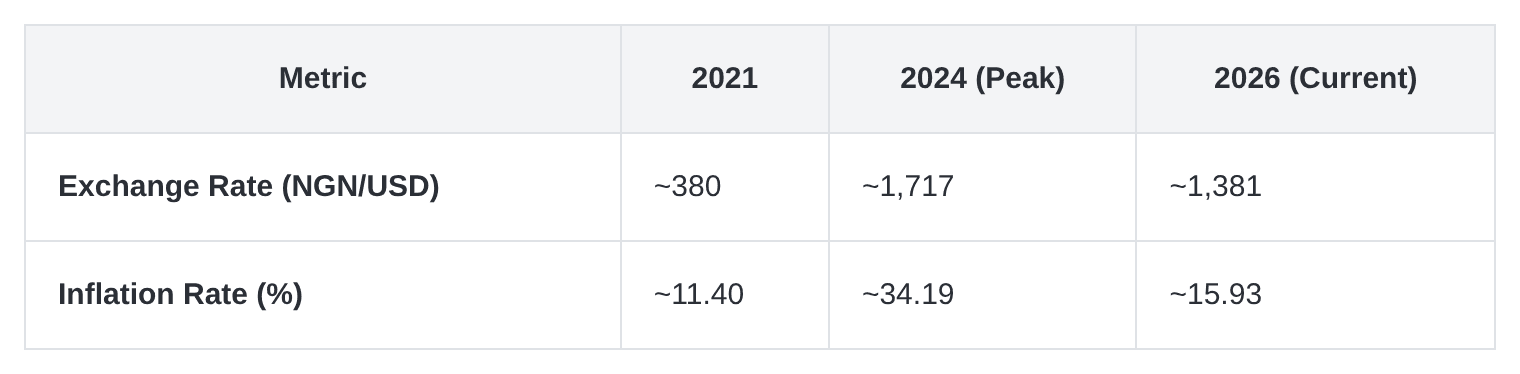
For the average Nigerian, the volatility of the national currency is not a theoretical concept discussed by economists; it is a daily reality reflected in the rising cost of staples at the market and the shrinking value of monthly salaries. Between 2021 and 2024, the Nigerian Naira underwent a historic slide, moving from approximately 380 NGN/USD to an all-time high of 1,717 NGN/USD in late 2024 [1]. While the currency has found a measure of stability in 2026, trading around 1,381 NGN/USD, the cumulative loss in purchasing power has been profound. In this climate, Bitcoin has transitioned from a niche interest to a critical financial lifeline for millions seeking to preserve their wealth.
The Dual Threat: Devaluation and Inflation
The urgency behind Bitcoin adoption in Nigeria stems from a "pincer movement" of economic pressures. Savers have had to contend not only with the currency's external devaluation against the dollar but also with rampant domestic inflation. In June 2024, headline inflation peaked at a staggering 34.19% [2]. Although inflation has cooled to approximately 15.93% as of May 2026, the real-world impact remains severe. For anyone holding savings purely in Naira, these two forces have worked in tandem to erode the value of their labor.
From Gray Market to Regulated Asset
The regulatory journey of Bitcoin in Nigeria has been as volatile as the currency itself. In February 2021, the Central Bank of Nigeria (CBN) issued a directive prohibiting banks from facilitating cryptocurrency transactions. Rather than stifling the market, this move catalyzed the growth of one of the world's most robust Peer-to-Peer (P2P) ecosystems, as Nigerians bypassed the banking system entirely to trade directly with one another.
Today, the landscape is significantly more structured. The Investments and Securities Act (ISA) 2025 has formally classified digital assets as securities, bringing them under the oversight of the Securities and Exchange Commission (SEC) [3]. This legislation requires platforms like Quidax, Busha, and NairaEx to obtain licenses to operate, providing a layer of investor protection that was previously absent. Furthermore, the CBN's reversal of its banking ban in late 2023 means that licensed exchanges can now officially interface with the traditional banking sector, although some internal compliance lags persist within individual banks.
A Practical Playbook for the Modern Saver
For Nigerians using Bitcoin as a hedge, the strategy has shifted from speculative trading to long-term wealth preservation. The most effective approach involves Dollar-Cost Averaging (DCA) - the practice of converting small, regular amounts of Naira into Bitcoin regardless of the current price. This method smooths out the impact of Bitcoin's own price volatility, which remains a significant risk for those with short-term liquidity needs.
The goal for many is not to 'get rich quick' but to ensure that the money they earn today can still buy the same amount of bread, fuel, or tuition five years from now.
Practical safety remains paramount. While licensed local exchanges offer convenience, many experienced users still advocate for self-custody - holding one's own private keys rather than leaving funds on an exchange indefinitely. This minimizes "platform risk" ensuring that even if an exchange faces regulatory or technical hurdles, the individual's savings remain accessible.
The Verdict: A Necessary Alternative
Bitcoin is not a risk-free asset, and its sharp price swings mean it is ill-suited for emergency funds or short-term expenses. However, when compared to a national currency that has lost over 70% of its value against the dollar in five years, the risk profile of Bitcoin appears in a different light. For the Nigerian population, Bitcoin has become more than just a digital currency; it is a pragmatic tool for financial sovereignty in an era of economic uncertainty.